Friday, May 28, 2010

A Teller Is Available

"A Teller Is Available", currently on view at venues throughout Greensburg, does a masterful job of leading the viewer away from his or her accustomed role of passive observer towards the much more dynamic situation of being an active participant in the creation of this provocative piece of performance art. This ongoing performance raises difficult questions about the role of the artist, and the loss of the artist's identity in the artwork itself.

The basic elements of this artwork are simple. All of the performances take place at “Banks”, spaces that vary only slightly from Bank to Bank. You enter the “Lobby”, a fairly open area with a table containing various documents necessary to conducting business with the Bank. After choosing from a range of possible transactions, you take your place in a line, waiting for your chance to interact with the artist or “Teller”. Strategically placed ropes create a labyrinth for you to walk as you approach the central area of the performance. The meditative quality of walking the labyrinth seems to prepare the viewer for the encounter with the Teller.


The time it takes to make your way to the front of the line varies depending on the number of participants in the performance and the complexity of the transactions that they choose to perform with their Teller. The mood in the line tended towards boredom, with a hint of impatience at viewers who seemed to be making unnecessary demands on the Tellers. But this preliminary wait seemed to heighten the experience of hearing a Teller call out “Next, please”, accompanied as it was by the realization that you were, indeed, now entering the performance as a full participant.

Documents in hand, you approach the “Teller Window”. The Teller Window was basically a gap in a wall allowing you to interact with the Teller without actually entering the Teller’s space. The wall rose to approximately eye level, and the “window” was a shallow tabletop inset at about chest height into the wall upon which documents could be passed between the Teller and the viewer, with about 6 inches of free space between the tabletop and a thick piece of glass that filled the gap up to the top of the wall. Nothing about this arrangement hampered communication between the Teller and the viewer, but it created a clear sense of our space versus the space of the Tellers.

At this point, you the viewer become the “Customer”. On the days when I witnessed and participated in the performance, the exchange between Teller and Customer typically consisted of several distinct steps. Both Teller and Customer are standing, with the Teller Window between them. The first step was “Small Talk”, often consisting of a question for the Customer such as “Is it still raining out there?” The Teller’s existence as part of an artwork separated from “the real world” was emphasized by these questions. The Customer was brought to realize that he or she could leave at any time, whereas the Teller was essentially trapped within the performance. After the Small Talk, the Teller queried the Customer as to the nature of the transactions that they were going to perform. The Customer then hands the Teller the forms which had been prepared in the Lobby. The Teller takes the forms, and consults the Bank as to the feasibility of conducting the requested transactions with the Customer. The fate of the Customer is being “Told” here, as the Bank, not the Teller, has decided the success or failure of the Customer’s transaction.

Here the Teller truly becomes an interface for the Bank, and it is this point in the performance that the strangeness of the roles being played was the most striking. Where earlier the Teller had some freedom to modify the performance, such as replacing “Is it still raining out there?” with “How old is your little girl?” in the Small Talk, at this point in the piece the Teller loses his or her autonomy to make decisions, and simply must either complete the transaction if it met with the Bank’s approval, or reject the transaction if some criteria of the Bank’s was not met.

If the Customer’s attempts to conduct business with the Bank fail, the forms are returned to the Customer. If, on the other hand, the transaction is successful, the Customer is provided with a small printed “receipt” to keep as a record of their participation. Either way, the Customer leaves the performance with some documentation of the event, though the documentation does little to record the human interactions between artist and viewer. The performance typically ends with the Teller wishing the Customer “a nice day”.

As you leave the Bank and head towards your car, you are left to ponder the performance that you just helped to create. Has the artist been sacrificed to make the artwork, swallowed up by the Bank for eight hours a day, repeating the same actions again and again for the edification of each new viewer? Is the artist a Teller when no one is at the Teller Window? Once again it is demonstrated that the artwork only exists in the presence of a viewer, that we make the artwork as much as the artist. Consistent with the history of performance art, questions about art as a commodity have been raised - was the artwork's value dependent on the funds being exchanged by the Bank and the Customer, or was the performance itself the thing of value? Many viewers, in their roles as Customers, were powerfully moved by their interactions with the Teller. Was this a testament to the skill of the artist, or was it more of a reflection of what the viewer brought to the performance? I think it is this last point that made the strongest impression on me, that "A Teller Is Available" ultimately acts as a mirror of the viewer - it’s your response to this powerful and poignant performance that creates the meaning of the work, and whatever you were "told" was something that, on some level, you already knew.

Thursday, May 27, 2010

Monday, May 24, 2010

Charcoal Heart

After finishing the latest little book I don't feel like I'm at all finished with the images I used. So I'm working on a few little charcoal drawings. We'll see where they go.


charcoal on BFK Rives, 12" x 16"

Saturday, May 22, 2010

The Moist Towelette Museum

We were eating at The Summer Place the other day, where you can get really great barbecue, but only in the summerish seasons, and I was struck by the wonderfulness of the packaging of the "moist towelette" that had been thoughtfully provided with my sandwich.


I was reminded of a class in early Italian Renaissance art that I took as an undergraduate, where we were asked to attempt to date an image we hadn't seen prior to the final exam based on what we knew of the artists and styles that we had studied. It seems to me that an expert in mid-twentieth century graphic design could date this "moist towelette" packaging pretty precisely. The font, the geometric abstraction, the palette - it's pretty terrific.

So, of course, a little poking around on the web reveals a very wonderful Moist Towelette Museum, where you can revel in the beauty of as much moist towelette packaging as you can stand.

Friday, May 21, 2010

"Moore's Law is a violation of Murphy's Law. Everything Gets Better and Better"

Subscribers to the FIMP book club can start looking in their mailboxes for this month's book, as it went to the post office today. Here's page 4:


This was a fun book for me, as it grew in ways that I really enjoyed. There are two poles to the way these books develop. One end of the spectrum is when I come up with an idea or storyline or concept for the book that is ready-to-go - I just need to execute it. I don't really trust that model. Fortunately, things always grow more complex as I try to bring that idea to life, so the book usually exceeds in interest the limitations of the initial idea. The other pole is where I just have a seed to start from - some little "wouldn't it be fun to work with that", and see where it takes me. That usually produces a better book.

This one started from an impulse to make a book without using the computer or photography. Just me and a pen. No subject matter or content concerns at the beginning, just the idea of stepping away from the digital for a while. From there I went to working with small still life objects, then I had to decide what objects would make sense or complement this retreat from the digital. . . I ultimately chose to draw things that were both mechanical or organic or both, and things that somehow dealt with the passage of time. And the text ultimately grew from the objects.

In other words, I learned a little bit about why I had certain things cluttering up my studio and my head by making the book. That's far more interesting to me than simply illustrating something I already "knew".


To be true to the "concept" I had to draw the logo as well.

Now, back to the sketchbook, camera and mousepad. . .

Tuesday, April 27, 2010

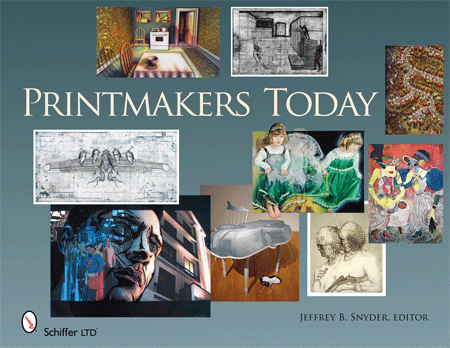
Printmakers Today


I am delighted to tell you that six of my linocuts have been included in Printmakers Today, a beautiful, 256 page, full color book presenting the original prints of 63 contemporary artists. Each artist is represented by six images and an artist's statement. The reproductions average about 4" x 6", with some like my Justice linocut reproduced at 6" x 9".


All of the artists represented in the book are artist-printmakers. In other words, these aren't artists who work primarily in another medium and have been invited to make prints by a professional shop - these are all folks who have ink in their blood. It's great to see a collection of top-notch original prints by true printmakers lovingly reproduced in full color in such a handsome hardcover book.

Printmakers Today is published by Schiffer Publishing. It was expertly compiled and edited by Jeffrey B. Snyder. Amazon has listed a release date of June 1. It's a real winner, you should add it to your library.

Friday, April 23, 2010

Friday, April 16, 2010

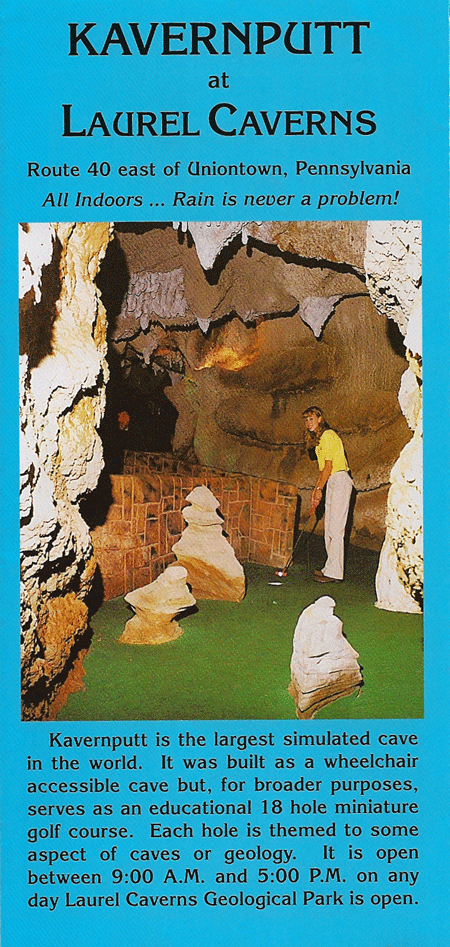
Kavernputt!

You know sucks about caves? No miniature golf. That's why I love Kavernputt.

Monday, April 12, 2010

Rachel Draws Dinosaurs


This is a two-page spread from a book about dinosaurs that Rachel is drawing. This book flickers in and out of existence as pages drawn on her Magna Doodle. You can see one of the dinosaurs walking from one page to another. She often draws multiple pages of a story this way, drawing a couple of pages, erasing them, drawing the next ones. . . You have to be present to witness the story. But one thing I've definitely learned about kids is that you definitely have to be present.

I've started to collect Rachel's daily drawings at Rachel Draws A Lot.

Tuesday, April 06, 2010

The Red Menace


An animation from images that Steven LaRose and I were batting around back in 2008.

"ME, An Autobiography" by Darrell Kinsel


The Fiji Island Mermaid Press is delighted that Darrell Kinsel has added his "ME, An Autobiography" to the FIMP "ME" book library.

This is an ongoing project in which FIMP provides the format and the questions, and you provide all of the answers! Darrell's book is the 26th in the gallery - is your book next?

If you're interested in participating, you can get the details and a downloadable blank book here.

Monday, April 05, 2010

Saturday, April 03, 2010

Best Parts List Ever

We bought a string of lights to hang on our picnic table umbrella. It came with a surprisingly thick set of instructions, including this parts list:


It was a relief to spread it out on the floor and compare it to the drawing to see that we did, indeed, have a string of lights.

Friday, April 02, 2010

Tuesday, March 30, 2010

Life's Questions Answered


6 pages from "Life's Questions Answered by the good citizens of Hamden Connecticut, as found in the Hamden Journal Photo Forum".


The local paper would do a "man on the street" style feature every week, with photos and quotes from passers-by answering that week's question. I gathered these up, and presented the answers as published, with only one small tweak. I changed the questions.

Friday, March 26, 2010

New blog links for your reading and viewing pleasure

I added a few links to a few blogs that you should take a few minutes to check out:

More Regrettable Incidents in a Life Filled with Bitter Remorse, which you will find in the Blogs of Interest sidebar under "David Fullarton", because I couldn't be bothered to type "More Regrettable Incidents in a Life Filled with Bitter Remorse." David Fullarton makes pictures with words on them.

Simon Goode A talented book artist. Besides following his blog, you should check out his website, especially his wonderful book Agglutination.

Bike Snob NYC Some really great writing about things bicycle in New York City.

Slice Harvester Some really great writing about things pizza in New York City.

Wednesday, March 24, 2010

AL'S

Out driving around last weekend I saw a very large sign by the road that looked pretty much like this:


By large we're talking billboard size. I loved it for a couple of reasons. It gave you no clue about the business (store? restaurant?) except that it was owned by Al, and it got the apostrophe right. It was very legible. A good sign that said almost nothing.

So I started thinking about signs I'd seen that weren't as good as AL'S. I decided that if I were to be forced to open one of those fake stores in a place like Williamsburg or Epcot Center, I would name it:


Then I challenged myself to come up with a business name that would be so repellant that I would refuse to shop there. Not repellant due to political concerns, or the nature of the business, but from being the polar opposite of AL's sign. So here it is:


It gets the apostrophes wrong. The backwards "N" is in quotes, just like the annoying backwards "R" in Toys "R" Us. It doesn't tell you what you can buy there, but you know the place has a very sickly sweet smell that makes you wonder how the sales staff tolerate it for any length of time. It uses multiple fonts, and is hard to read. It has cute fake olde spelling.

Though, I have to admit, one of my favorite store names was one of the models for this. If you drive through Blawnox PA you will find "Pianos N' Stuff". I've always loved that name. I've never been in the store, but I'm always intrigued by the vagueness of the "stuff" combined with the much more specific "pianos". If it were my store, there would be mostly pianos, with a few mops, lightbulbs, and bags of dog food scattered about, and maybe one of those rotating hot dog grills or a cotton candy machine. Y'know, stuff.

Tuesday, March 23, 2010

American Dreaming


The cover and a two page spread from "American Dreaming", one of the artist's books that FIMP has mailed out over the past 10 years.

Friday, March 19, 2010

Makes A Lousy Gift!


The first two pages from "Makes A Lousy Gift! 6 Things You Shoudn't Give That Special Someone: A Catalog of Poor Choices for Discerning Persons".

Tuesday, March 16, 2010

Spring is in the air. . .


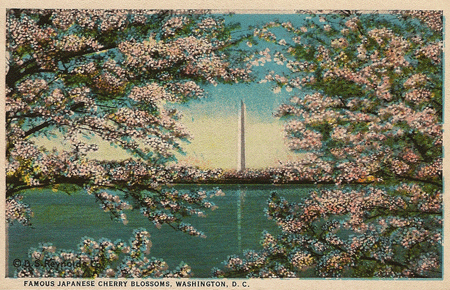
What with the snow melting and green things starting to appear around the yard, I thought I would post this energetically misregistered image from an old postcard, to help encourage Spring to keep springing.