This is the second etching I've made using solarplate, and I'm really enjoying the process. The major drawback is that the plates can't be reworked like a traditional etching plate, which limits the amount of plate history in the image, which is one of the major attractions of etching for me. So I imagine that I will use this technique primarily to add photographic material to more complex collage/multiple printing element images in the future. But I am really happy with my first couple of plates as stand-alone pieces!
So, do you ever have one of those moments in the studio where you say "gee, so that's what I've been thinking about"? They're nice, aren't they. I just had one, courtesy of Judith Hoffman, an artist who does fantastic things with metal and artist's books, by way of a comment she left concerning Zero Sum #21. I had mentioned that I was enjoying working with my new box, as it reminded me of theaters, and puppets, and cameras, and she pointed me towards ShadowLight Productions, a shadow puppet theater company founded by Larry Reed. So I wandered over to YouTube. . .
and was blown away. Isn't that great stuff?! One of my favorite things about that is the flames used as the light source for the shadow puppets in the traditional production. So, after my video-watching-adrenaline rush subsided, I thought about some drawings I had made in the past.
That drawing was one of a bunch of pieces I made for a show I called the Existential Theater. I made those drawings back in 1996. At the time I was really interested in making images that had a mix of drawing from the model and drawing from casts, and I enjoyed how the viewer would bring figures to life even if they were made from disjointed parts. What I wasn't really thinking about at the time, but which I'm finding more and more intriguing these days, was the way these drawings were really a species of still-life, but a form of still-life that looked to the stage for inspiration, in the contained spaces and dramatic lighting and deployment of figures in the images. The theatrical aspect was obvious, but I wasn't as focused on the "still-life".
So in 2004, I go to this puppet show at Bard College,
a performance of "Nevsky Prospekt", by the Russian puppet theater company "Theatre Potudan". It blows me away. Just incredible. It was a miniature stage, with wonderfully beautiful and strange and delicate puppets. The imagery was frequently very surreal. And yet, as an audience member, you were fully involved with these puppets as living beings. One of the wonders was that, with such a tiny stage, the viewer was seated just a few feet from the performers, and the fact that these performers were made of paper and sticks and strings was celebrated, not hidden. Though you understood them to be puppets, the suspension of belief, the empathy you had for these objects, was just breathtaking.
The climactic moment of the production involves the suicide of the main character. This is shown by way of the puppeteer's hands entering the stage, gathering the puppet's strings, and cutting them. That cliched metaphor of the puppet's strings, so often used to symbolize being in someone else's control, here was turned around to show us the strings as the very life-force of the puppet. Which, of course, they are. After the puppet falls limp to the stage, the hands reach down and cradle the lifeless form. Gosh, it was beautiful.
I left that production just astonished. That was some seriously powerful stuff. I didn't have a place for it in my own studio practice at the time, but boy, I wished I did.
I recently became aware of a project that William Kentridge did in 2005, the "Black Box"
or "Chambre Noire". Kentridge's work has me all fired up as well, with his combination of drawing, animation, and puppetry. And in this particular project, his building of a mechanical miniature stage in which the lighting of scraps of drawings and wire, their movement through the space and the shadows they cast, the use of some images as "characters" and some as "setting", all resonates with me.
And, thinking about all of that, makes me realize how I'm digesting those influences in my own work. When I started the Zero Sum Art Project I didn't realize that I would start accumulating these strange objects in my studio, and I certainly hadn't planned on building a stage to place them in. I hadn't planned on incorporating photography, and I didn't realize that collage would play such a large role in the artwork. It's kind of delightful that these things have happened, but it's only now that I'm really seeing the relationship of those choices to a lot of things I've worked on and looked at and thought about in the past.
Zero Sum work in progress
So thanks for the heads-up, Judith, I really appreciate it!
FIMP's production line is running at full tilt - just stand back and watch your fingers, please - to bring Book of the Month Club subscribers this month's book. "News You Can Use" - 3 true stories, 3 valuable lessons. Well, the stories are true, anyway. Or, well, true in the sense that someone published them as news. OK, how about "News: A book divided into thirds". That about covers it.
I found this video over at notebookism, a blog that feeds my addiction for all things paper, especially bound paper. It's a beautiful little video essay on letterpress by Chuck Kraemer, featuring John Christensen and his Firefly Press:
It warms my printmakerly heart to see that.
If you want to get your hands on some letterpressed poems, you might find some scattered here and there through the efforts of the Guerrilla Poetics Project. The GPP is being celebrated in this article from the September/October issue of Poets & Writers.
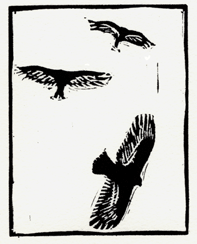
That little linocut is one piece of a jigsaw puzzle I'm putting together that will ultimately be a broadside featuring a poem by Ron Offen, to be published by Pygmy Forest Press. Stay tuned for more details as they happen. . .
And if you haven't been over to the Zero Sum Art Project blog lately, you might have missed Zero Sum #20 - which, by the way, you could purchase if you visit this auction before Sunday night.
Here we see my toddler daughter's first foray into photography, a no-holds-barred, impressively unsentimental image of her old man. Most of her energy in the studio to date has been directed towards her installations, "scatter pieces" that display an impressive disregard for creating objects with any kind of permanence.
In making this photograph, she craftily transferred some of the strategies that she has used in her installation work to raise interesting questions about authorship and the role of the subject in the taking of a "portrait". Her method involved tossing a disposable camera on to the floor in front of her subject, seemingly by accident. I was unaware that she had managed to both wind the camera and prime the flash. Upon reaching down to pick up the camera, the flash fires, and an image that certainly resonates as a portrait from a toddler eye's view is created.
In light of the previous post's discussion of the role of the viewer in creating the artwork, I enjoyed finding this quote from Yuka Yamaguchi on her wonderful blog plastique monkey:
Art is like being a farmer. I’m farming my brain and my heart and my hand to grow something. After that, it’s up to other people to cook it in different recipes and digest it for themselves.
A conjuror is an actor playing the part of a magician. Robert-Houdin
Art is the lie that tells the truth. Pablo Picasso
One of my FIMP books from 2001 was "How To Be A Magician In 3 Easy Steps":
Consistent with every other FIMP "how to", you learn nothing of value relative to the title of the book, of course. But I've long thought that art and magic have a lot in common. There is the shared quality of being activities that require the mastery of a unique set of skills to produce a result with no real practical value, but more important to me is the role of the viewer in both cases.
Mark Tansey. The Innocent Eye Test. 1981.
I'm not really talking about the piece of conjuring that Mark Tansey illustrates above, a painting that creates a representation of a thing so "true to life" that it could be confused for the thing itself. I'm talking about the magic trick of convincing an audience that this thing you have made is somehow important and meaningful, that you have taken base materials and through some strange alchemy in the studio created "art". It's really the audience, and not the artist, that takes that object and makes it art.
Marcel Duchamp. Fountain. 1917.
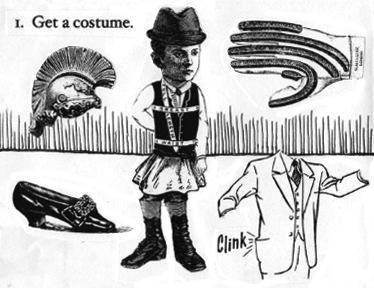
Marcel Duchamp really taught us this lesson in 1917 with his sculpture "Fountain". With this "readymade" (his term for a sculpture composed solely of a found object displaced from the real world and placed into the realm of art), he declares that an artwork is anything an artist says it is. This, of course, leads you to the question, "well then, who is an artist?" I'd say, an artist is anyone the audience (ultimately) says it is. If the book above were "How To Be An Artist In 3 Easy Steps", the hopeful reader might get a costume (I'm an artist!), learn how to do odd things in ways that baffle and amaze people (I made this show full of really exciting stuff!), and then try to find an audience that finds that stuff baffling and amazing. Without that audience, it's just a pile of stuff. With that audience, it's art.
So, anyway, this piece by Damien Hirst that everyone's already probably seen by now:
Damien Hirst. For the Love of God. 2007.
a skull cast in platinum and encrusted with 8601 diamonds, that cost him $20 million to make, is so lacking in magic. The only part of this piece that seems to attempt to baffle and amaze is the pile of money that went into making it. It strikes me as sort of a dodge - a way to avoid all of those messy attempts at meaning, or even novelty, and replace them with an astonishing price tag. You'd think that with my Zero Sum Art Project, and its obsessive recording of every cent spent along the way to making the objects being sold, that I would find Hirst's transformation of $20 million dollars into $100 million dollars more interesting. But I just can't.
What I really want to see is an artist taking an ordinary deck of cards and doing something astonishing with them. Speaking of which, here's one of my heroes, Ricky Jay, doing just that:
When we watch a masterful magician work, we know we're seeing deceptions, but we want to see magic. And we see magic. When we look at an artist's work, we want to see art. And we see art.
Here's "Verse 3", the next in a series of small collages that seem to be an irresistable byproduct of working on the Zero Sum Art Project. As with 1 & 2, Verse 3 is being sold on eBay, where you will find more information about how the image is put together and a detail of the collaged and painted surface.
Of course, "Verse 3" quotes an extremely famous photograph. There are three photographs that date from my early childhood that are indelibly burned into my mental image bank, this one being the street execution of a Viet Cong officer photographed by Eddie Adams in 1968.
Eddie Adams, 1968
As I was working with that collage, I started thinking about the lasting power of those 3 photographs from the Vietnam war. Though the subject matter is horrific, their strength is also that of the crafted image.
John Filo, 1970
There's a bunch of reasons why this photo by John Filo won a Pulitzer Prize, while
this one is relatively unknown, and the grieving figure of Mary Ann Vecchio is only one of them. It must be a terribly strange and awkward feeling to be witnessing a tragedy and on some level know that you just put together a fantastic image.
Huynh Cong "Nick" Ut, 1972
And the third image from that time that I can't escape, and that I no doubt share with many of you out there, is of course this one from 1972 of the terrified children escaping the napalm.
I've been thinking about how different those three photographs are from so much of the imagery we are seeing these days. Partly we have the dilemma of the journalists being embedded with the troops, and a much greater awareness by the military of the need to control the images being released in the media. Digital technology is also a major change - the most potent images coming out of our current conflicts are those captured with cell phones and portable digital cameras.
The Abu Ghraib photos come foremost to mind. But these photos are snapshots of atrocities, souvenirs of violence. The story they are telling includes an element of "hey, look what I just did". We can't empathize with the photographer, so our horror is doubled, at both the atrocity portrayed and the motives of the photographer. We're looking at trophies instead of journalism.
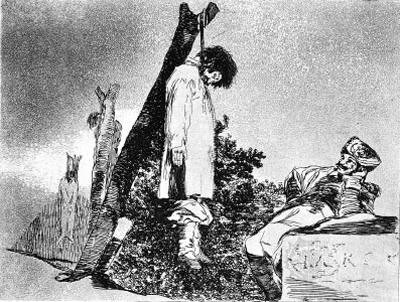
Of all of those horrible photographs, this hooded figure had to become the iconic image. It could be straight out of Goya's "Disasters of War".
"No More", etching from the series The Disasters of War by Francisco de Goya, 1810–14
Looking at those etchings from almost 200 years ago, and holding them up to what we're seeing today, it's awfully hard to believe that we're really capable of learning anything.
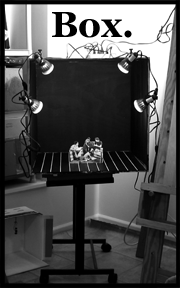
Subscribers to FIMP's Book of the Month Club should be receiving "Box" in their own boxes in the next day or two.
As with the Verse collages, "Box" is partially a spinoff from work I'm doing for the Zero Sum Art Project. The imagery in "Box" starts with photographs of a 2 foot cube I've built as a stage for photographing and drawing objects that have accumulated in the Zero Sum studio. Plato wasn't very impressed with artists, as he felt that we just further obscured peoples' view of reality, and I think that "Box" would just reinforce his poor opinion of us. Sorry, Plato!
In other Book-of-the-Month news, "Thinking about Thinking" will be reproduced in a textbook about digital photography this fall.
"Light & Lens: Photography in the Digital Age is as an introductory text that clearly and concisely instructs people in the fundamental, “forever” aesthetic and technical building blocks necessary to create thought-provoking digitally based photographs and features works of 150 international artists." (from author Robert Hirsch's website, Light Research).
Robert Hirsch does fantastic work - explore his site! His "World In A Jar" is a recent installation that is really amazing.
If you were in Akron Ohio on July 21, you should have been at the Derby Downs for the 70th All-American Soap Box Derby World Championship. Fortunately for FIMP, C. Hayes was there with her camera, documenting the occasion for all of us who missed it.
The official track is 989 feet, four inches long. The record time set by one of these gravity-powered racers on the current track length is 28.24 seconds, by Hilary Pearson of Kansas City in 2004.
All the cars are built from kits by the kids. Many of them have sponsors supporting them, and you know that I'll be eating at the Underpass Grill the next time I'm in Ogallala, NE.
The gentleman in purple is the oldest living derby racer! Speaking of the oldest living racer, you can find a very thorough history of the Soap Box Derby at All American Soap Box Derby website.
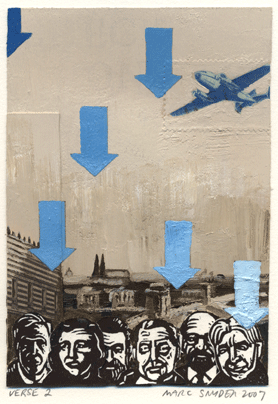
Here's "Verse 2" for your viewing pleasure, continuing the little series of spin-off works from the Zero Sum Art Project. For some cheap summer thrills, I'm selling these on eBay with the auction starting at a penny - you can visit the auction to see a few details of the paint and collage elements.
The small crowd at the bottom is made up of bits and pieces from 24 Poets and 1 Astronaut, one of my linocuts from 2002. Never throw anything away - if you saw my studio you'd know I live by those words. Prints that don't make the final cut for an edition are always good as collage material. The palette for the little cityscape is based on an old postcard - that's an idea I first started playing with in Zero Sum #16. Ideas are something you can always return to, just like bits of old prints. . .
Why $13.32, you might ask? If you're unfamiliar with the Zero Sum Art Project, you can find an overview of the operation on the Digging Pitt blog. ZSAP will be on display there in November - it'll be a nice complicated puzzle to solve, putting the exhibition together within the rules of the project.
It was kind of inevitable that the artwork I'm doing for the Zero Sum Art Project would start spilling over into the rest of my studio work. Here's a little collage that's representative of the bits and pieces of things that I'm knocking around these days.
Since sending out "50 Places I've Already Seen" about a month ago, I've heard from a surprising number of subscribers telling me their tales of spudnutty goodness. In the book I had intentionally left out the exact whereabouts of my "places", hoping to inspire readers to fill in the blanks with their own beloved little spots. But information about spudnuts seems to be in demand, so for those of you that need a potato-flour-doughnut fix, the Spudnuts I had in mind was the Spudnuts in Charlottesville, VA, which happens to be the last remaining Spudnuts on the east coast.
Now, as our great good luck would have it, FIMP's Philosopher-In-Residence Paul Moriarty happened to be visiting our old undergraduate stomping grounds last week, and brought back confirmation that Spudnuts is still going strong.
My understanding is that as you travel west, you are more likely to encounter a Spudnuts here and there. These guys could probably give you directions.
The FIMP Book of the Month is "Casting Call: Seeking Animal Talent for the Title Role in CRAZED DESPOT"
In Casting Call you'll find six head-shots of animals in full "power-hungry military leader" costume, fresh from their auditions for the title role in "Crazed Despot". True to FIMP book form, these are probably not animals that will be called back for a second look. If you're not a subscriber to the FIMP book of the month club, and you want one of these tiny books for your very own, you can pick one up on ebay.
Subscriber's to the Fiji Island Mermaid Press Book of the Month Club should already have "50 Places I've Already Seen". It's an autobiography of sorts, playing off of the popular "1000 Places You Should See Before You Die". Part of FIMP's way of seeing things is to try and love the place you're at - that's something I learned from dogs and babies. So this book celebrates those places that you probably didn't plan your trip around, but are awfully darn wonderful anyway. Everyone's list would be different - a self-portrait.
The artist as a young man, searching for the fountain of youth at the Ripley's Believe It or Not Museum
The image above didn't make it into the book, but is undoubtedly a formative one. I think that's the first place I encountered the Fiji Island Mermaid. It's amazing that I can type this blog entry, considering what those crocodiles were doing to my hands.
In other news, the Zero Sum Art Project continues on its merry way, with Zero Sum #16 currently up for sale. Visit the auction on eBay to see the entire painting/collage.
If you're in or near PIttsburgh, you should stop by the Digging Pitt Gallery this weekend, for the closing reception of Marci Gehring's show. The painting shown above (borrowed from Digging Pitt's website) is a floor to ceiling piece that is really quite wonderful. The artist manages to create images with very intensely worked surfaces that reward close inspection, while still working on a very large scale. Great stuff! The closing reception is June 2, from 6 - 9, and the gallery is open Thursday through Sunday if you can't make the reception.
And, should you be thinking a little further ahead, you might also want to jot down June 16 in your calendar book. That's the date for the opening reception of Inside Out Six: Selections from the Flat Files - Side II, also at Digging Pitt. This is a show curated from Digging Pitt's extensive flat files, and I'm delighted to say that I'll be one of the fourteen artists included in the exhibition.